
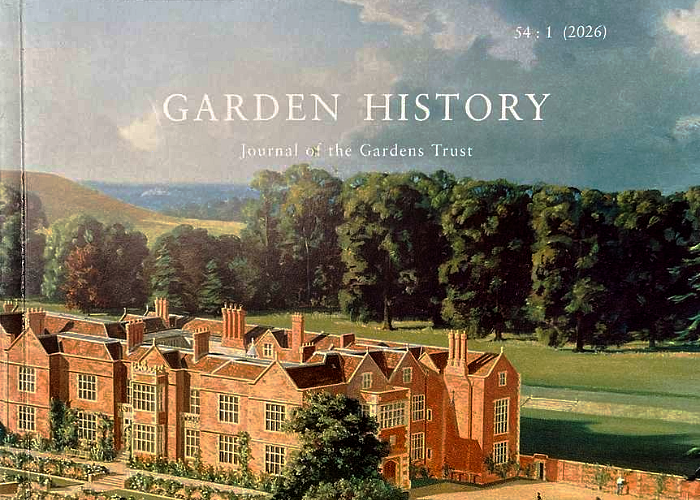
Garden History is one of the foremost journals in its field worldwide and remains the journal in which to be published for those dedicated to garden history scholarship, with its wide academic and professional readership.
“From the earliest issue to the present, Garden History is an enormously important and relevant source of information, providing vital support to the Gardens Trust’s promotion of the study of garden history, landscape gardening and horticulture. Its reviews section also offers timely and critical reflection upon recent published work in the field.”
Dominic Cole, CMLI FIOH VMM OBE, President of The Gardens Trust
Contents of Garden History
The Gardens Trust (formerly the Garden History Society) has been publishing academic articles on the subject since 1969, if you include our two early Occasional Papers. Many articles originally published in Garden History later led onto work that became the classic books on the subject. All articles remain in print and are available through JSTOR.
You can download a list of all the articles and authors published in Garden History, and its predecessor volumes, from 1969 up to the present, which includes details of how to read or obtain the articles.
To search the lists for authors or topics, use CTRL+F for the PDF file or if using the Word doc, download and open it first before using the same CTRL+F command to open the navigation pane.
50th Anniversary Edition
In 2022, we produced a 50th anniversary celebratory volume revisiting some of the seminal articles that had been published in the previous 49 volumes and pairing them with articles by a distinguished panel of experts reflecting on their significance and updating research on the topic.
We are grateful to the Finnis Scott Foundation and many individual donors for the support that made this publication possible. The anniversary edition can be viewed on our dedicated website and it is also available to purchase at £20 by emailing membership@thegardenstrust.org
Supplements, Appendices and Gazetteers
Some issues or information are only available on-line and can be seen below (free of charge).
- Garden History 54 Cave Appendix Summer 2026
- Garden History 52 Pointer Appendix Winter 2024
- Garden History 50 Pointer Gazetteer Summer 2022
- Garden History 47: Supplement 1 Spring 2019; Humphry Repton and Horticulture
- Campbell article appendices
- Garden History 46: supplement 1 Autumn 2018; Edward Kemp (1871–91): Landscape Gardener
- Garden History 43:1 Summer 2015; Plants of Croome 1746–1813
- Garden History 43: supplement 1 Spring 2015; The Proceedings of the Edinburgh Gardens and Squares Conference
Contributions for future issues
The editor welcomes the submission of any article that significantly advances our understanding of the history and conservation of gardens and designed landscapes. Articles should ideally be up to 6,000 words in length, though longer contributions will be considered on their merits. Shorter articles may be published as ‘Notes’. We advise all contributors to consult our updated Garden History submissions guide.
Contributions for publication should be submitted to the Editor: Dr Barbara Simms at journal@gardentales.co.uk.
Current editions are around 200 pages, with from 5 to 10 articles, and notes, per edition. The journal is printed using soya based ink, recycled, carbon balanced paper and biodegradable mailing film.
Back issues of Garden History journal
You can download the Cumulative Index of all editions of Garden History (only up to 2000) and the Society’s other publications.
Members of The Gardens Trust receive a copy of each new journal as it is published, usually twice yearly. All back issues of Garden History and our two earlier Occasional Papers are available and cost £18.00 (plus postage and packing, and including VAT; at cost overseas); for prices for bulk orders please contact us. Alternatively you can read and download articles on JSTOR (for which we make a small charge, currently $6 US, unless you have free access). We have a three-year embargo, so the most recent editions can only be read in traditional paper form.
To order back issues, please email us at membership@thegardenstrust.org
If you have further queries, phone: +44 (0)20 7251 2610
Editorial Team and Advisory Board
Editor — Barbara Simms PhD (2004–)
Assistant Editor — Cristiano Ratti DPhil (1998–)
Founding Editor — Dr Christopher Thacker (1970–80)
Garden History Editorial Advisory Board 21-25
Gabor Alfody MA, Budapest, Hungary
Patrick Bowe, Dublin, Ireland
John Edmondson PhD, Holywell, UK
Brent Elliott PhD, London, UK
Alison Hardie PhD, University of Leeds, UK
David Jacques PhD, Sugnall, UK
Sally Jeffery PhD, London, UK
Marcus Köhler PhD, Technical University, Dresden, Germany
Mark Laird, Toronto, Canada
Verena Mauldon MLitt, New South Wales, Australia
Eeva Ruoff PhD, Aalto University, Finland
Boris Sokolov PhD, State University for the Humanities, Moscow, Russia
Michael Symes MPhil, London, UK
Judith B. Tankard MA, New York University, USA
Marc Treib, University of California, Berkeley, USA
Stephen Wass PhD, Oxfordshire, UK
Jan Woudstra PhD, University of Sheffield, UK
__________________________________________________
Previous Editors
Dr Christopher Thacker (1970–80)
John Anthony (1980)
W.A Brogden BArch, PhD (1981–3)
Brent Elliott PhD (1984–8 and 1989)
Robert Oresko (1988)
Jane Crawley and Elisabeth Whittle (1989–97)
Dr Jan Woudstra PhD (1998–2004)
Andrew Eburne PhD (2004–06)
Previous Editorial Advisory Board members
Andrew Eburne PhD, Norfolk, UK
Colleen Morris MHerit.Cons, Sydney, Australia
Timothy Mowl DPhil FSA, University of Bristol, UK
Elizabeth Barlow Rogers, New York City, USA
Ada Segre PhD, Bologna, Italy
Joachim Wolschke-Bulmahn PhD, Leibniz University of Hannover, Germany
Behind the Scenes at Garden History
Garden History contains a selection of articles on a wide range of topics related to garden history and conservation. The articles for each issue will have been carefully chosen from the many submitted and will have been through the editing and refereeing process before being sent for layout, proofing and publication. Garden historian Barbara Simms as editor and architectural historian Cris Ratti, who lays out the issue, have worked together on the journal for many years, but also key to its delivery is the journal advisory panel, members of which are appointed for a five-year term.
The advisory panel is comprised of academics and practitioners from a broad geographical base and with a wide range of interests and expertise with the aim of maintaining and improving the scholarly standards of the journal. This might be by refereeing articles, providing information on developments in their area of specialist interest, encouraging readership in their own geographical region and academic area and, perhaps, submitting an article for publication. The current five-year term is coming to an end, and readers might be interested to know more about the fourteen panel members appointed for the January 2027 to December 2031 period.
GÁBOR ALFӦLDY
A landscape architect with an MA in Conservation Studies (York) and a PhD in Art History (Budapest). He works as a research fellow at the Institute of Art History, Eötvös Loránd University, within the Research Centre for the Humanities in Budapest. His main areas of interest are the history of gardens and the garden and landscape heritage of Central Europe. Between 2001 and 2015, as Head of Gardens at the Hungarian State Centre for Heritage Management, he oversaw the maintenance, research and conservation of dozens of historic gardens and parks including Fertőd-Eszterháza, Dég, Doba and Füzérradvány, and worked as a project manager. Drawing primarily on his studies in the UK, he introduced the methodology of conservation plans and conservation management plans to Hungary, which has since been incorporated into legislation. In 2008, he was awarded the Europa Nostra Medal for the conservation plan for Somlóvár Park, Doba. His publications examine various aspects of eighteenth- to twentieth-century Central European garden design, as well as the life and oeuvre of significant designers.
PATRICK BOWE
The author or co-author of ten books on gardens and garden history and has published in an international range of academic journals on garden history. He succeeded Sir Geoffrey Jellicoe as garden designer at Sutton Place near Guildford.
JOHN EDMONDSON
Studied botany at Durham and Edinburgh Universities, with a PhD from Leicester. In the 1970s he assisted Professor Peter Davis in editing The Flora of Turkey at Edinburgh’s Royal Botanic Garden before spending twenty-nine years as Curator of Botany and Head of Science in National Museums Liverpool. His primary focus has been on the flora of the Middle East, serving as co-editor of The Flora of Iraq (for Kew) and visiting Iran, Oman and the UAE on plant-collecting trips. He is currently a trustee of the Welsh Historic Gardens Trust.
BRENT ELLIOTT
Spent forty years working at the Royal Horticultural Society’s Lindley Library, for twenty-five of them as chief librarian, and for the last ten as historian. During that time, he also served as a committee member of the Victorian Society, the Garden History Society and English Heritage, as an examiner for Thames Polytechnic, and as President of EBHL (the European Botanical and Horticultural Libraries group). He was awarded the Veitch Memorial Medal by the RHS, and the Greensfelder Medal by the Missouri Botanical Garden. He has served as a trustee or advisory committee member for Kensal Green, West Norwood, and Highgate Cemeteries. His charitable work included over twenty years’ membership and eventual chairmanship of the Merlin Trust and continues with his work as a trustee of the Finnis Scott Foundation. His books and articles deal primarily with garden history, the history of botany and the history of botanical art; the books range from Victorian Gardens (1986) to The British Cemetery: Architecture, Landscape, Sculpture (2026, with Roger Bowdler). He edited Garden History from 1985 to 1988.
DAVID JACQUES
Head of Historic Parks and Gardens at English Heritage 1987-93 before returning to consultancy, for example on Chiswick House Grounds, the Privy Garden at Hampton Court and the Earl of Leicester’s garden at Kenilworth Castle. He was for six years the Programme Director of Landscape Conservation & Change at the Architectural Association. He advised on Hampton Court for twenty-five years and was a trustee of the Chiswick House and Gardens Trust for fourteen years. Among his works are Georgian Gardens: the Reign of Nature (1983), The Gardens of William and Mary (1988), Landscape Modernism Renounced: The Career of Christopher Tunnard (1910-1979) (2009), Gardens of Court and Country: English design 1630 to 1730 (2017), Chiswick House Gardens: 300 Years of Creation and Recreation (2022) and Tudor and Stuart Royal Gardens (2024).
SALLY JEFFERY
An architectural and garden historian. She was historian at the City of London for many years, researching the historic buildings and gardens belonging to the City. She then helped to set up the Birkbeck (University of London) MA Garden History and later taught on the Institute of Historical Research MA Garden and Landscape History. Over the years her research has covered a wide area of architectural and garden history. Her interests are now mainly concentrated on the seventeenth- and eighteenth-century house and garden, including the architecture and gardens of Hugh May at Moor Park and Eltham Lodge, and on Nicholas Hawksmoor at Wray Wood, Castle Howard. Her most recent work has been on later seventeenth-century gardens, particularly those where George London or his nursery was involved.
MARCUS KӦHLER
Studied art history in Berlin and London; held a research fellowship in Washington DC; wrote a dissertation on early landscape gardens; and has been Chair of Garden History and Garden Conservation since 2014, initially in Neubrandenburg (Mecklenburg) and, since 2014, in Dresden. He publishes the online magazine Aha! and is involved in numerous associations and organisations. Research topics include orangeries, gardens in the context of climate change, gastronomy, early landscape gardens and garden iconography. His present garden focus is the three countries of Poland, the Czech Republic and Germany.
MARK LAIRD
Professor Emeritus at the University of Toronto, having taught landscape history for fifteen years at Harvard University’s Graduate School of Design. He is the author of The Flowering of the Landscape Garden (1999), A Natural History of English Gardening (2015) and The Dominion of Flowers (2024). He acted as co-curator/co-editor of Mrs Delany and her Circle (2009). He was research fellow at both Chelsea Physic Garden and Dumbarton Oaks, where he later served as a Senior Fellow. As Historic Planting Consultant, he has advised on heritage sites in Europe and North America, including Painshill, Strawberry Hill and Wrest Park.
BORIS SOKOLOV
An art and garden art historian, translator and landscape photographer. He has a PhD in art history (Russian popular prints, 1993) and a Dr Hab in art history (Wassily Kandinsky’s symbolic forms, 2003). He is based at the Russian State University for the Humanities, Moscow, where he teaches a course on the History of Landscape Art. He is also on the Board of the Society for Preservation of Russian Country Seats. Publications include The Landscape Park in Europe and Russia: Enlightenment to Romanticism (2017), Gardens of the Russian Symbolism (2022) and Green Palaces: Five Centuries of Regular Gardens (2025) and has several books in preparation.
MICHAEL SYMES
Has long experience of being on the advisory panel for Garden History. His own interests are focused on the eighteenth-century garden mostly in Britain, but also encompassing continental Europe, especially Germany, which possesses a formidable depth and quality of garden scholarship. He encourages potential authors to contribute to Garden History.
JUDITH B. TANKARD
An art historian with an MA from New York University, specializing in garden history. She is the author or co-author of eight books on the history of British and American garden design and the founder of the Journal of the New England Garden History Society (1991-2003). She has written articles and book reviews for Country Life and Hortus (among others) and her latest book is Gertrude Jekyll at Munstead Wood (2025).
MARC TREIB
Professor of Architecture Emeritus at the University of California, Berkeley. He is a historian and critic of landscape architecture and architecture and an honorary member of the American Society of Landscape Architects. His publications span a wide range of modern and historical subjects concerning architecture, landscape architecture and art in the United States, Japan and Scandinavia. More recent books include The Landscapes of Modern Architecture: Wright, Mies, Neutra, Aalto, Barragán; The Aesthetics of Contemporary Planting Design; Serious Fun: The Landscapes of Claude Cormier; The Shape of the Land: Topography and Landscape Architecture; Poodling: On the Just Shaping of Shrubbery; and Noguchi’s Gardens: Landscape as Sculpture.
STEPHEN WASS
Has an MA Historical Archaeology (Distinction) from the University of Leicester and a DPhil Architectural History from the University of Oxford. As a freelance archaeologist with over thirty years of experience, his primary research interests are in landscape archaeology as applied to historic gardens and parks with a special focus on water features. He is currently following up on a programme of doctoral research with the University of Oxford centred on the little-known Jacobean gardens of Hanwell Castle, Oxfordshire. He also undertakes a variety of commercial projects, mainly for the National Trust, including being the lead archaeologist on the current extensive programme of restoration at Stowe Landscape Gardens.
JAN WOUDSTRA
A landscape historian, who trained in landscape architecture and horticulture, initially in The Netherlands continuing at Kew and the University of York. After working in private practice, during which time he taught at the Garden Conservation course at the Architectural Association, he completed his PhD at the University of London. He taught at the Department of Landscape Architecture, now School of Architecture and Landscape at the University of Sheffield for thirty years, being offered an honorary professorship on his retirement. He has researched a considerable range of topics and has published widely. His forthcoming book on the nineteenth-century landscape gardener Robert Marnock (1800-89) is due to be published with Boydell and Brewer in 2027.

