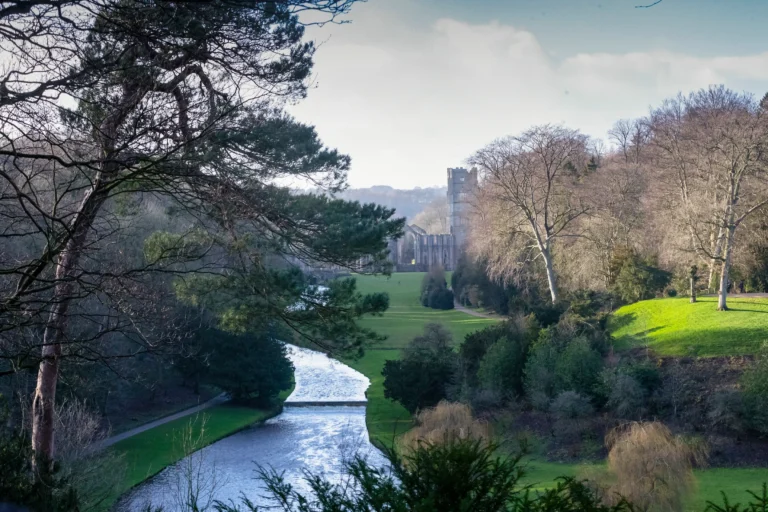
Allée
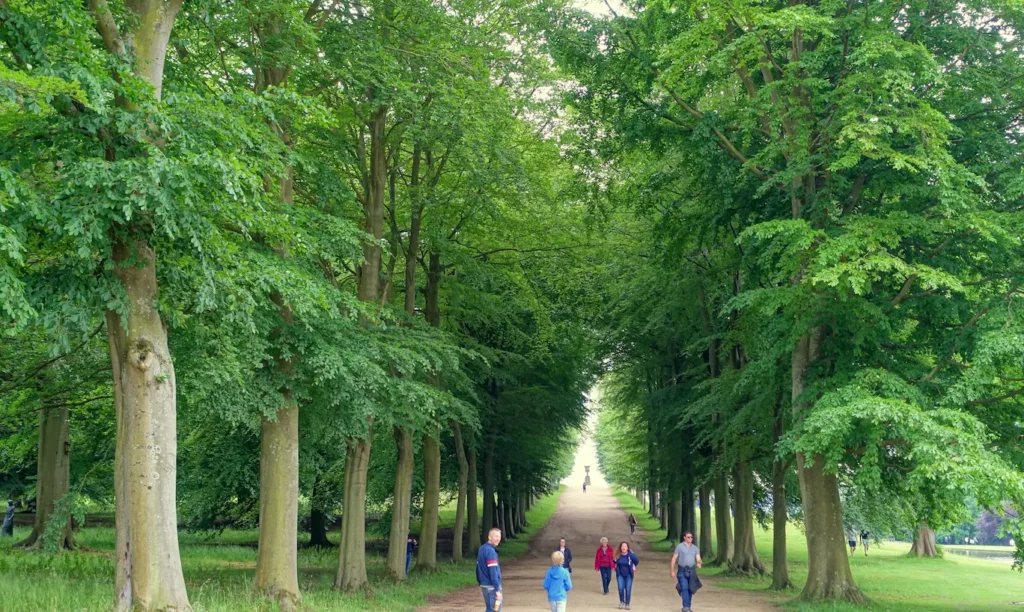
(French). A straight walk in a garden, lined by trees or hedges. It is of gravel, sand or turf and has some breadth, though not as much as an avenue. It often creates a vista, with an object of interest (building, etc) at the far end.
American garden
A garden planted with species obtained from, or native to, North America. The idea evolved during the eighteenth century, when, through the Bartrams in Pennsylvania and Peter Collinson in London, many trees and shrubs were made available to owners and designers in England. Humphry Repton designed American gardens for a number of sites including Ashridge, Hertfordshire, and Woburn Abbey, Bedfordshire, while William Beckford created an enormous American plantation at Fonthill, Wiltshire. Many conifers were grown, together with rhododendrons, magnolias, azaleas, tulip trees and liquidambars. By the 1840s the term was extended to refer to an area in which acid-loving plants from many parts of the world were grown.
Anglo-chinois
The French term for the English landscape style of garden. When the pictorial English landscape movement reached France from the middle of the eighteenth century, the French believed that the style owed as much to Chinese irregularity of form as to English ideas. This was fanned by the popularity of the French translations of Sir William Chambers’s works on Chinese gardens and designs. The concept was vigorously rebutted by Horace Walpole, among others, who attributed it to jealousy: ‘they deny us half the merit or rather originality of the invention, by ascribing the discovery to the Chinese.’
Arts and Crafts (late Victorian and Edwardian)
The movement initiated by John Ruskin and William Morris led, in gardening, to the use of traditional crafts and materials for garden structures. In layout and planting, however, there was no single approach to follow, and gardens could vary from the informal cottage garden to Lutyens’s ordered geometry, where the hand of the architect was evident.
Banqueting house
A garden room or house away from the main house, for eating and entertainment. In Tudor times at least, the eating was confined to light refreshment (desserts and confectionery) rather than serious feasting but, later, more substantial meals were served. The Banqueting Hall at Mowbray Point, Hackfall, North Yorkshire (c.1750), has a kitchen and servants’ hall nearby, while the Banqueting House at Studley Royal, North Yorkshire, originally an orangery (1730), had a kitchen subsequently attached. A memorable Gothic banqueting house at Gibside, County Durham (1751), has been restored.
Baroque (in Britain, late seventeenth/early eighteenth centuries)
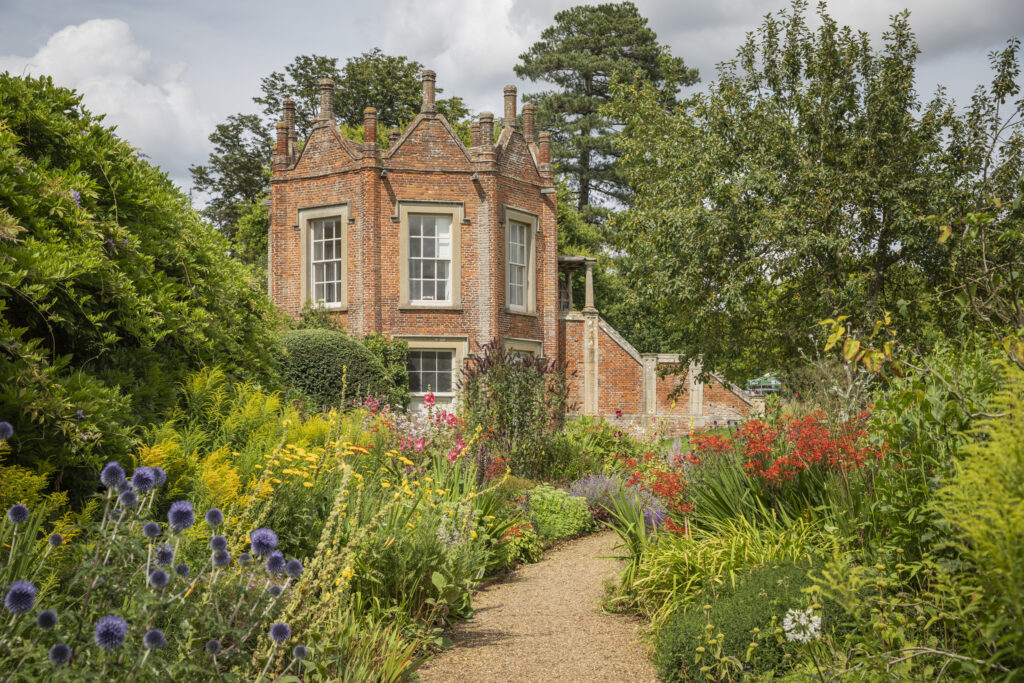
Formal French-style layout on a grand scale.
Bosquet (French)
A planted grove or shrubbery either in solid blocks (usually of the same species) or cut through by walks. See Wilderness for the English equivalent.
Brownian
Exhibiting the characteristics of ‘Capability’ Brown’s style of landscape gardening. Brown was pre-eminent in the period 1750-80, during which he established a reputation for working to a recognisable pattern. The elements were: rolling green slopes and lawns that came up to the house; trees dotted about singly or in clumps, particularly on hills; a perimeter belt of trees; a boundary drive; a lake of natural appearance in the middle ground. Brown had many followers who adopted his style.
Canal
In gardens, an artificial sheet of water, usually rectangular in shape. The purpose may be functional (as a reservoir) as well as decorative, but the latter usage is particularly marked in formal gardens of the grand French manner. In Britain the Long Water at Hampton Court, Middlesex, is a notable instance of a dominating canal on a main axis relating to the house; smaller, but no less attractive, examples are at Erddig, Wrexham; Westbury Court, Gloucestershire; and Wrest Park, Bedfordshire. An unusual slanting T-shaped canal is at Bramham, West Yorkshire.
Carpet bedding (primarily Victorian)
The practice of forming beds of low-growing foliage plants, all of an even height, in patterns that resemble a carpet both in the intricacy of their design and in the uniformity of surface. Flowers were gradually admitted, reluctantly at first. It was introduced by John Fleming at Cliveden, Buckinghamshire, in 1868 and has continued to be employed, especially in public parks. Designs can vary from geometrical to images and lettered inscriptions. A fine example is at Eastbourne, East Sussex.
Chahar bagh
This concept, Persian in origin, constitutes the basis of the Islamic garden. It consists of four divisions within a square, the divisions being marked by four arms of a canal in the form of a cross, meeting at the central point.
Chinese
With a garden tradition stretching back longer than that of any other nation, there is no such thing as a typical Chinese garden. However, the dominant elements are rocks and water: rocks are often piled up to form artificial crags, and their hardness contrasts and harmonises with the soft, reflective water. The visitor passes through the garden as if on a journey, experiencing incidents and features from different angles, even within a small area, by means of contrasts (high and low levels, light and shade). Trees are valued for their symbolic associations and plants for their scents.
Cloister garden
An ornamental garden within the cloisters of medieval monasteries. However, no firm evidence has been found for their existence, and it is more likely that a stretch of grass occupied the cloister area, with recreational and herb gardens outside.
Cottage garden
A garden attached to a cottage where the planting is informal, apparently artless, crowded with flowers, vegetables and fruit trees, with trailers, climbers and creepers on the woodwork.
Dutch
The elements of the traditional Dutch style (seventeenth century) represent an adaptation and modification of French formal ideas. Dutch gardens tended to be flat and compact, with an emphasis on small canals, hedges, topiary, lead statuary and flowering bulbs and shrubs. There are, however, one or two examples on the grand scale, such as the restored palace gardens at Het Loo. Westbury Court, Gloucestershire, gives a possible idea of the Dutch style as employed in England.
Exedra
In gardens, an area with a semi-circular backdrop, in the manner of an apse, found particularly in the eighteenth century. At Chiswick, Middlesex, the backdrop is formed of a hedge, in front of which stood three Roman statues; at Painswick, Gloucestershire, the exedra is architectural, a curving Gothic screen. An extraordinary curving hedge arcade shaped to form an exedra was once at Hartwell House, Buckinghamshire.
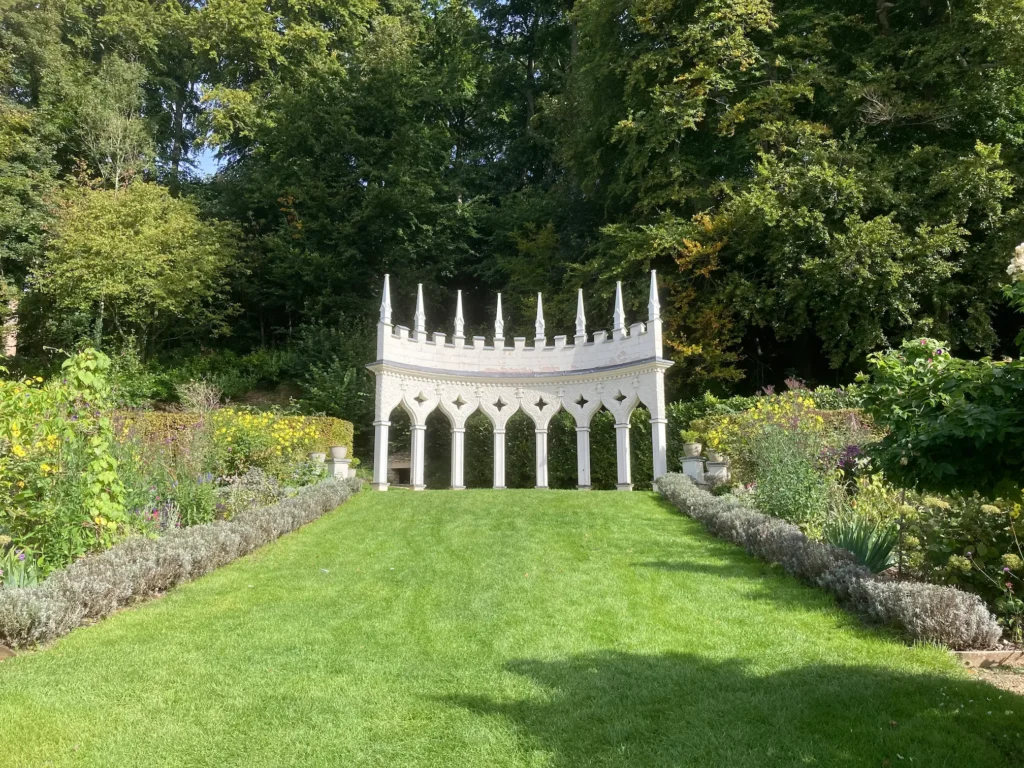
Eyecatcher
A feature placed on a distant eminence (but not necessarily on the owner’s property). The best-known is the façade erected by William Kent in a field opposite the garden of Rousham, Oxfordshire (1730s); another excellent example is the pinnacled façade at Creech Grange, Dorset (1740). Many buildings placed on a height remote from the house, like some of Sanderson Miller’s castles or Robert Adam’s temple at Audley End, Essex, can be regarded as eyecatchers.
Ferme ornée (French = ornamented farm)
A garden in which an operational farm is included in the overall design and where the farm both contributes to the effect and is itself planted up with ornamental trees and hedgerows. Although the term is French, the genre is predominantly English, with early eighteenth-century examples at Riskins Park, Buckinghamshire, and Dawley, Middlesex, being superseded by the great fermes ornées of the Leasowes, Worcestershire, and Woburn Farm, Surrey. At the latter, Whately tells us (1770) that out of 150 acres (60 hectares), 35 were cultivated as pleasure grounds, the remainder being two-thirds pasture and one-third arable, but that the ‘decorations’ were carried through all parts by means of a broad belt walk lined with colourful shrubs, trees and hedges.
Folly
In gardens, a structure that demonstrates eccentricity or excess rather than practical purpose: it may have been expensive, bizarre in design or with no apparent function or meaning. The eighteenth-century landscape garden is the arena in which follies flourished most readily, although they were not unknown in the twentieth century. They demand attention and were intended to impress, puzzle or just give pleasure. They can take many forms – sham castles, ruins, towers, grottoes, hermits’ cells.
Forest gardening
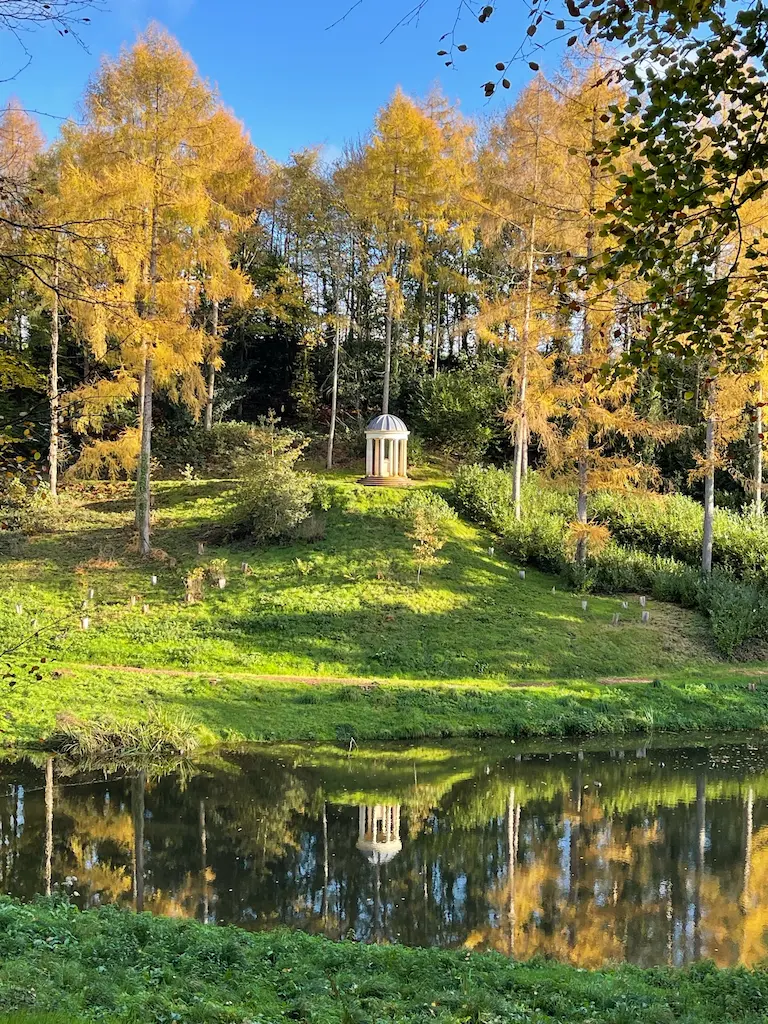
Also called ‘extensive gardening’, this was an approach advocated by Stephen Switzer (early eighteenth century) which unified the whole estate by means of great axial lines, and in particular brought forest plantation, though well away from the house, into the overall scheme. Cirencester Park, Gloucestershire, demonstrates his precepts best, with two enormous woods being yoked (‘willing woods’, as Pope called them) by means of the 5 mile (8 km) avenue to Sapperton.
French
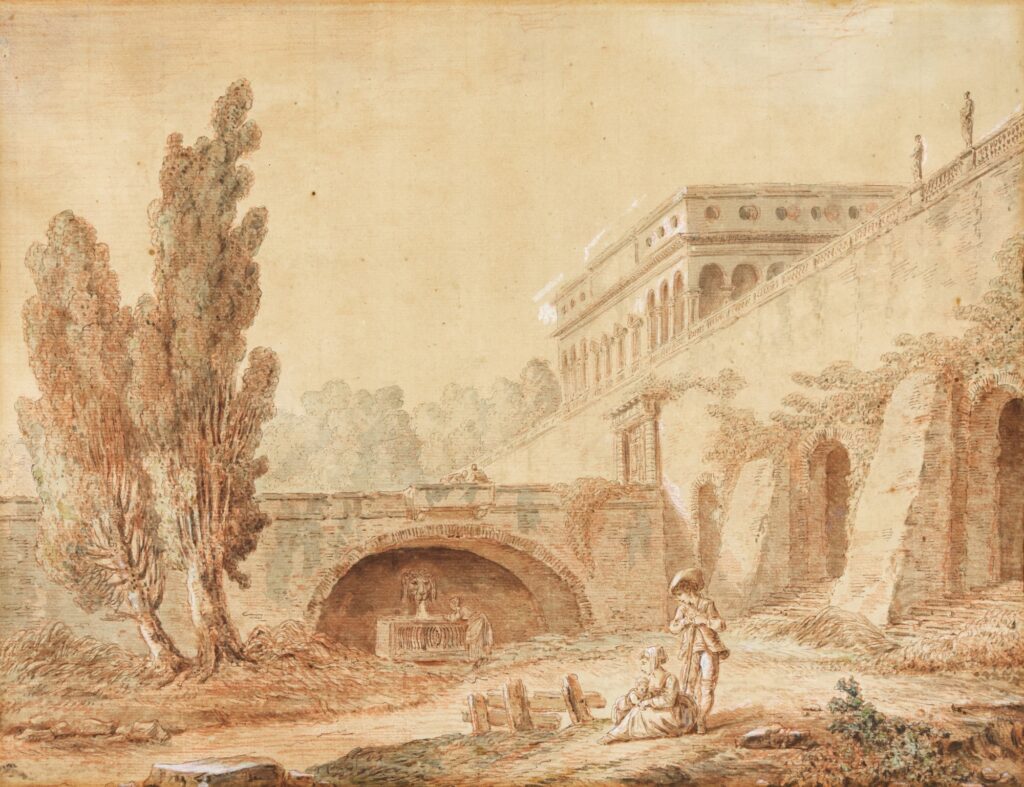
The French traditional style has much in common with the Italian and derived many ideas from it. The characteristics of a grand French garden are: a parterre or series of parterres adjacent to the house, with flowers and plants in regular beds, and fountains; stonework, balustrades and statuary; formal basins and canals, with cascades; away from the house a bosquet with walks cut through it; and long, broad avenues forming a grid pattern, with straight or diagonal axes leading back to the house. The archetype of this scheme is Versailles.
Gardenesque
A term coined by J. C. Loudon in 1832 for a style that allowed each plant to develop naturally and fully and to be displayed to its best advantage, i.e. the garden became plant-centred rather than plants being forced into a preconceived design. The concept was, however, modified, if not distorted, by later authors such as Edward Kemp (1850), who defined it as seeking beauty of lines and variety – mixed and irregular.
Gothic, Gothick
The Gothic revival in gardens in the eighteenth century in Britain saw the reuse of medieval features such as pointed arches, crenellation, buttresses and the ogee curve for the construction of garden buildings. In some cases there was an ideological motivation, namely to hark back to a former age of supposed virtues (eg. the Gothic Temple at Stowe, Buckinghamshire) and also to assert a British traditional style of architecture. Many architects essayed Gothic: William Kent, James Gibbs, Sanderson Miller, Robert Adam. Horace Walpole fostered Gothic revival in houses at his famous extravaganza at Strawberry Hill, Middlesex (1748).
Grotto
A cave-like chamber, often decorated with minerals, shells or pebbles. The sixteenth- and seventeenth-century French and Italian grottoes would be architecturally formal on the outside but inside would contain lavish ornamentation, often of a naturalistic kind. Those at Boboli, Florence, and nearby at the Villa Medici, Castello, had allegorical meanings. Water would frequently feature, as a pool, fountain or cascade. In Britain the grotto became more naturalistic outside as well as within during the eighteenth century, from Stephen Wright’s grotto at Claremont, Surrey (1750). Some were extravagant creations taking several years to build, such as the spar-decorated grotto at Painshill, Surrey, and the two-storey structure at Oatlands, Surrey. The most celebrated grotto-builders were the Lanes, father and son, of Tisbury, Wiltshire.
Ha-ha
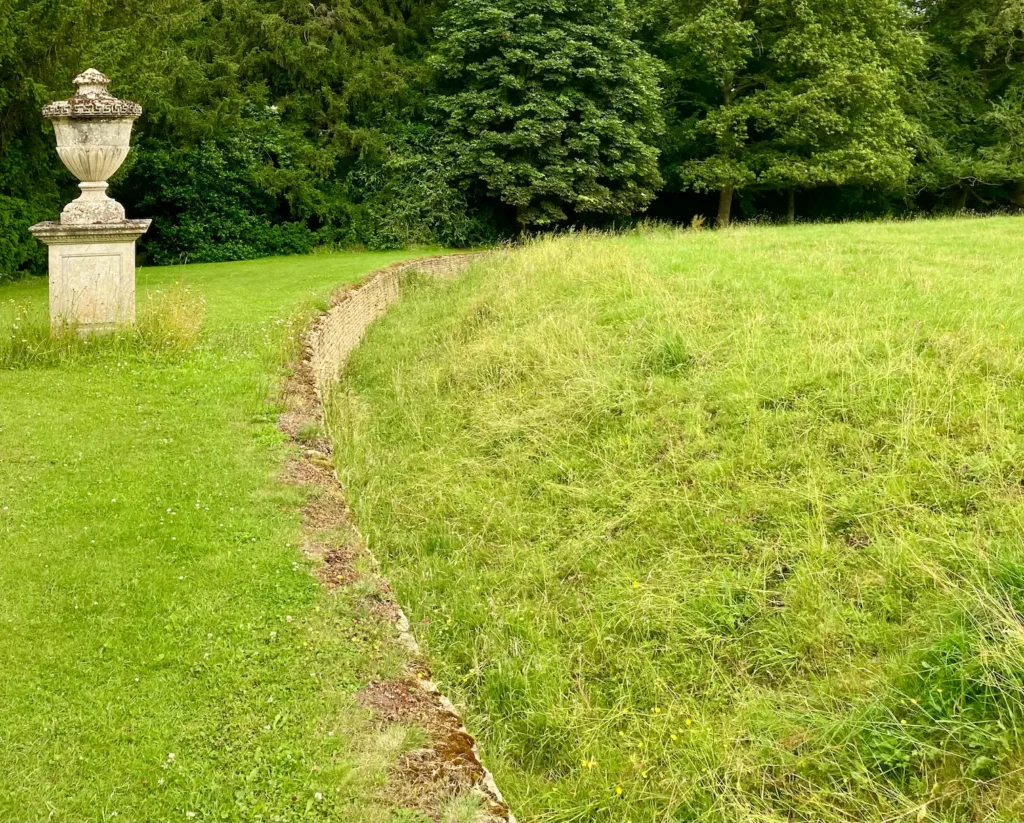
A sunk ditch, invisible from more than a few yards away, which divides the garden from pasture land outside. The purpose was to ‘call in the country’, to bring the fields into the garden and unify the two in design terms. The construction consisted of a retaining wall of brick or stone on the garden side and a sloping bank on the pasture side. This prevented cattle from getting into the garden. The device was in widespread use in the eighteenth century. The name derives from the cry of exclamation (it should be ‘aha’) as one comes unexpectedly upon the ditch. The concept is described by Dezallier d’Argenville but was popularised in its recognisable English form by Charles Bridgeman and many others. The ha-ha at Rousham, Oxfordshire, still fulfils its original function.
Hortus conclusus (Latin = enclosed garden)
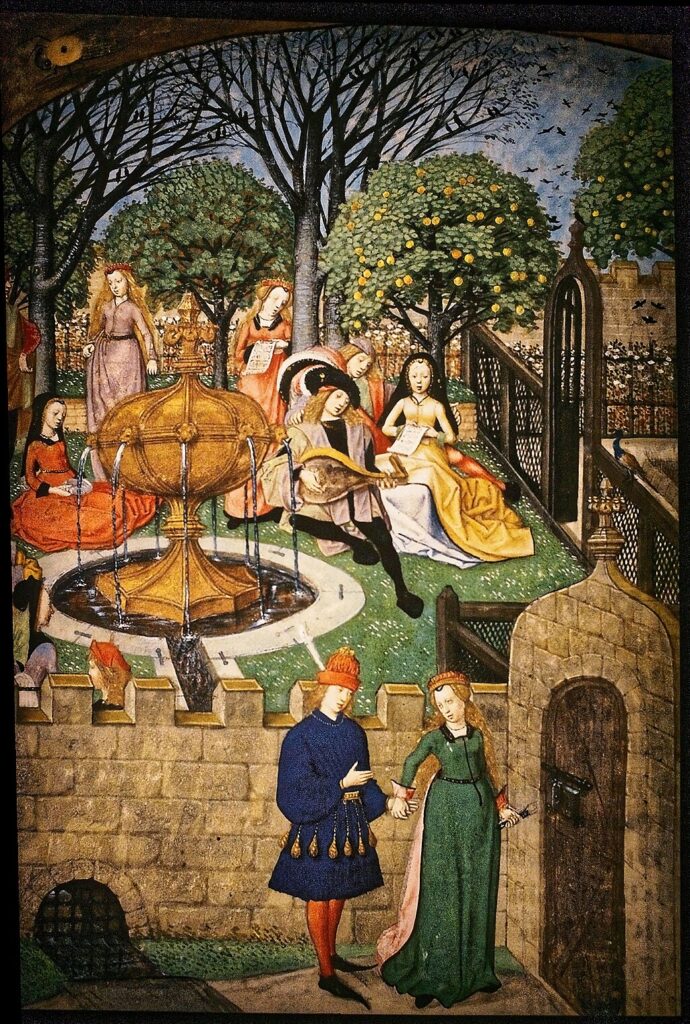
A secret garden within a garden. There is a literary/religious symbolism drawn from the Song of Songs which associated the Virgin Mary with the term: ‘enclosed’ represented her intact virginity, and the flowers of virtue would grow in the garden. In practice the enclosed garden was often a rose garden with fountains, walks and arbours, surrounded by a hedge or wall, sometimes with turfed seats, a lawn and paths. Some enclosed gardens were ecclesiastical, others secular, and their purpose was delectation and entertainment. Read our Garden History Hub article on the Hortus conclusus here.
Indian
Characteristic of the courtly Hindu or Mogul gardens are an emphasis on richly scented plantings, trees with dark spreading foliage for shade, use of striking colour and water in a central position, often with fountains. Indian motifs were occasionally taken up in western gardens, most notably in Sezincote, Gloucestershire (early 1800s), where, apart from the Indian-style house (which inspired the Royal Pavilion at Brighton), there are a Hindu temple and pool, a bridge with Brahminee bulls on the balustrade, a serpent and an Indian conservatory.
Italian
Normally understood as the characteristics of an Italian garden are the features associated with the elaborate gardens of the Renaissance – formal, geometrical layouts of lawn and paths, much use of stone steps, balustrades. statuary and fountains, terraces and ingenious water effects. Some of the gardens, like Bomarzo, Lazio, Italy, had an involved allegorical scheme that cannot be readily interpreted today.
Italianate
The term can apply to the use of (particularly Renaissance) Italian features in other countries at any period, including Britain, but has special reference to the High Victorian revival of terraced gardens such as at Bowood, Wiltshire, or at Shrubland, Suffolk, which has a magnificent series of steps between the five levels.
Jacobean garden
Following the Tudor period, Jacobean gardens were still formal in layout, containing topiary, knots, herb gardens and flower parterres. Elaborate Italian Mannerist water effects and grottoes were introduced at Somerset House and Greenwich, London, and at Richmond Palace Surrey.
Knot garden
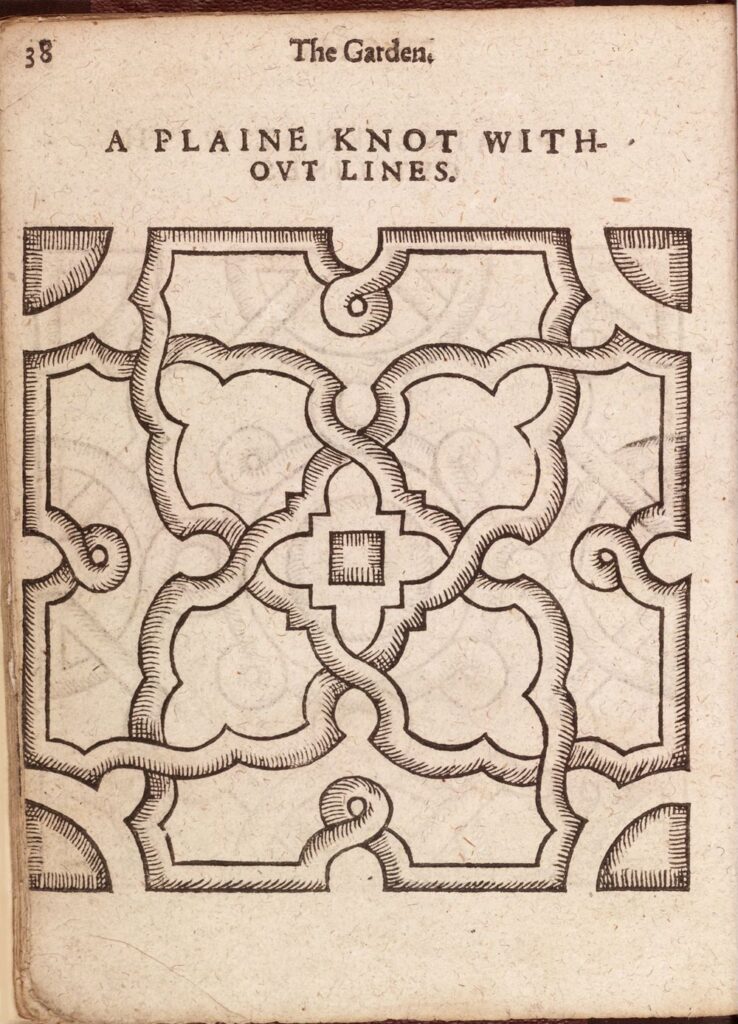
A garden plot which contains intricate designs resembling knots, common in English gardens of the sixteenth and seventeenth centuries. The outline of the knot would generally be formed by a low-growing hedge of box or a line of rosemary or thyme, while the spaces would be filled with flowers, coloured earth or gravel. Knots reconstructed in the twentieth century can be seen at Hampton Court, Middlesex; Sylvia Landsberg’s Tudor garden, Tudor House Museum, Southampton, Hampshire; Lady Salisbury’s at Hatfield House, Hertfordshire; and the Museum of Garden History, Lambeth, London. The terms ‘open’ and ‘closed’ knots are sometimes encountered, but there is confusion as to the precise significance of this distinction.
Landscape garden
A garden on a large scale, naturalistic in appearance and having no regularity of design. The concept was developed from early in the eighteenth century in England and by later in the century had spread widely not only in Britain but throughout Europe. It could embrace both the pictorial, temple-clad landscape such as Painshill, Surrey, or Stourhead, Wiltshire, and the park landscapes of ‘Capability’ Brown and his followers. Although the appearance was natural, a great deal of art in planning and planting often lay behind it. As the term suggests, the garden becomes a landscape and indeed often brings the farmland and countryside outside to the view as well.
Moorish
Some of the legacy of the Moors’ occupation of Spain is still to be seen in Spanish gardens: elements of patio, order, geometry, benches, walls, evergreens and division into a number of small compartments. Water was important, and this too was ‘divided’ into separate pools and fountains. The Generalife gardens of Granada give some idea of the Moorish style, although much modified over the years.
Parterre
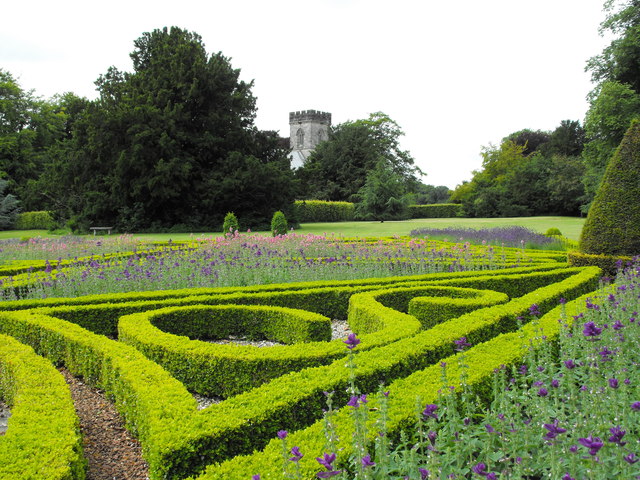
A flat terrace usually adjacent or near to the house and laid out with flower beds or other decorative patterns in regular formation, to be seen from above. A parterre in England could be entirely plain, simply turf with walks alongside. Philip Miller recommended oblong as a good shape for a parterre. A grand parterre of the seventeenth century, but much elaborated in 1830, can be seen at Drummond Castle in Perth and Kinross. A modern example is at Sledmere, East Yorkshire.
Patte d’oie (French = goose foot)
A feature common in French formal gardens, where several straight allées radiate forwards from a single point (usually the house). The idea may have come from Italian town planning: Palladio’s designs for streets in Vicenza show such a pattern. In England two notable examples are to be found in Lord Burlington’s Italianate garden at Chiswick, Middlesex (from 1715), while others survive at Inkpen Old Rectory, Berkshire (1695), St Paul’s Walden Bury, Hertfordshire (c.1725), and Bramham, West Yorkshire (1700-30), all of which were influenced by French layouts.
Picturesque
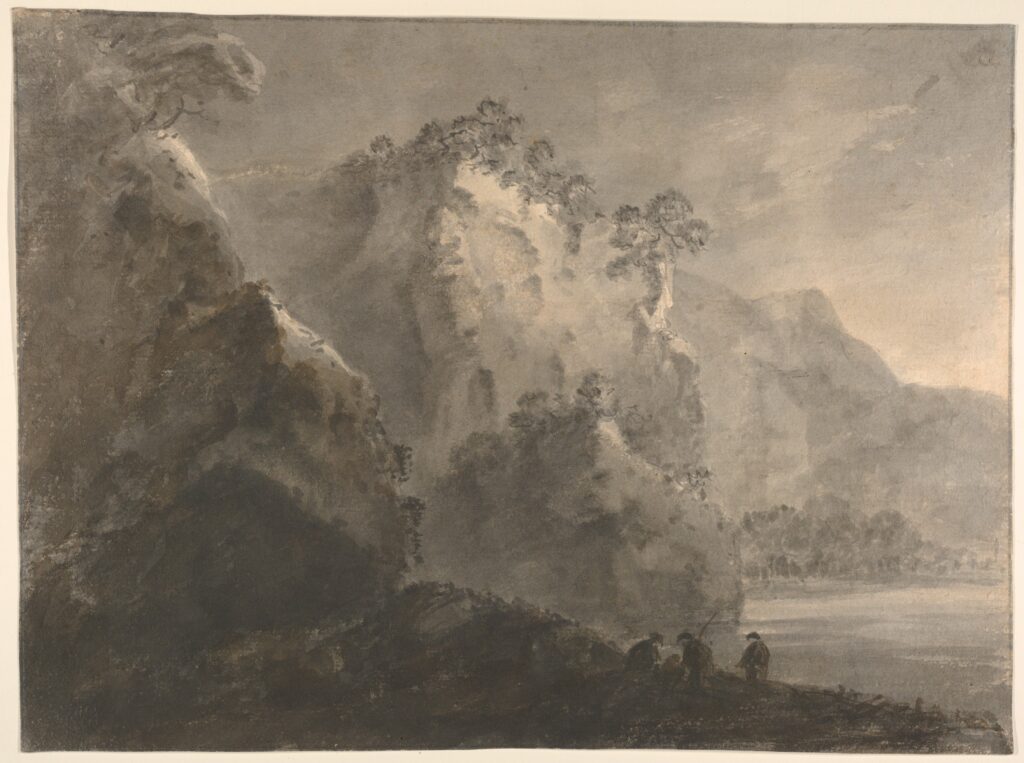
The Picturesque was a movement which reached its height towards the end of the eighteenth century. After William Gilpin (who first used the word in 1748) popularised the wild scenery of the Wye Valley and the Lake District from the mid century onwards, two Herefordshire squires, Richard Payne Knight and Sir Uvedale Price, sought to define the Picturesque as a particular type of scenery that was suitable for painting – broken, irregular, varied and often spectacular. Both men were firmly anti-Brown, whose work they found insipid and dull. In gardens the Picturesque approach is characterised by use of dramatic scenery (where it exists), contrasts of texture and vegetation, and a sense of wildness in that bushes, shrubs and trees are allowed to proliferate without apparent check, to give a shaggy or overgrown effect to the view. Picturesque gardens include Mount Edgcumbe, Cornwall; Wardour and Fonthill, both Wiltshire; and Payne Knight’s and Price’s own estates at Downton and Foxley, Herefordshire. Humphry Repton devised a rather cosier version, a sort of villa picturesque with flower gardens near the house. His larger landscapes were concerned with massing or thinning trees to optimise the view and to display the house in its best setting. Shrubberies in Regency gardens were also described as picturesque. Read our Garden History Hub article about the Picturesque here.
Pinetum
A collection of trees composed of conifers. The best example is Bedgebury Pinetum, Kent, but there are sometimes smaller-scale pineta within varied gardens, e.g. at Bowood.
Physic garden
A garden with medicinal plants. Historically the physic garden was concerned with the development of botany and had much in common with the botanic garden. But the term ‘physic’ (= healing) became attached specifically to the cultivation of herbs with medicinal properties. The Chelsea Physic Garden, London, was founded in 1673 and is still concerned with research and the study of plants.
Regency garden
A prominent characteristic of the gardens of early nineteenth-century England was an emphasis on shrubberies, sometimes in island beds and sometimes acting as boundaries between one area and another. The shrubberies would be colourful and grow lavishly, with a mixture of hedgerow planting and flowers. In Mansfield Park Jane Austen describes a hedgerow converted into a shrubbery. The Regency garden for the Royal Pavilion at Brighton, East Sussex, has been restored, with beds that push into the lawn, serpentine paths and undulations of ground.
Rococo (from the French, rocaille = pebblework or rockwork and coquille = shell)
A style characterised in the visual arts by playfulness, elegance, asymmetry and sometimes wilfulness. In English gardens the term may be applied to some smaller gardens of the mid eighteenth century, together with some individual buildings or other features in a larger garden, to demonstrate a light-hearted and fanciful approach which may take advantage of a number of different architectural styles – Gothic, Chinese, rustic. Rococo gardens include Painswick, Gloucestershire, which has some very quirky architecture and irregularity of path layout and Hampton Court House, Middlesex, with a heart-shaped lake, icehouse, fountain arch, exedra and superb shell grotto, all within a small compass. Rocks and shells often play a part, as for example in the ‘rococo valley’ at Bowood, Wiltshire, where a naturalistic waterfall covers a warren of passages, while two sets of rockwork formations line the cascade and the valley, and a Hermit’s Cell has ammonites in the ceiling.
In German gardens the term ‘rococo’ has been applied to a garden with a series of small garden rooms in a usually formal plan but containing rococo constructions – chinoiserie, ruins, grotesque figures and so on.
Roman
Classical Roman gardens were of varied kinds, as we can tell from archaeology, from remains and from descriptions: the enclosed peristyle garden, the sacred garden (e.g. the Canopus at Hadrian’s Villa, Tivoli, dedicated to the god Serapis), and large open areas where wild woods and pavilions and artificial trelliswork would be combined. Statuary featured prominently, as did plants and water.
Stove
A heated chamber or hothouse. In the seventeenth century they were so named because they were heated by Dutch stoves; later methods of heating included tan-bark pits and outside stoves, hot-air flues in the walls and, by 1800, hot water and steam. Humid and steamy tropical forest conditions could be produced that would foster exotic fruits and plants. They are found in most botanic gardens.
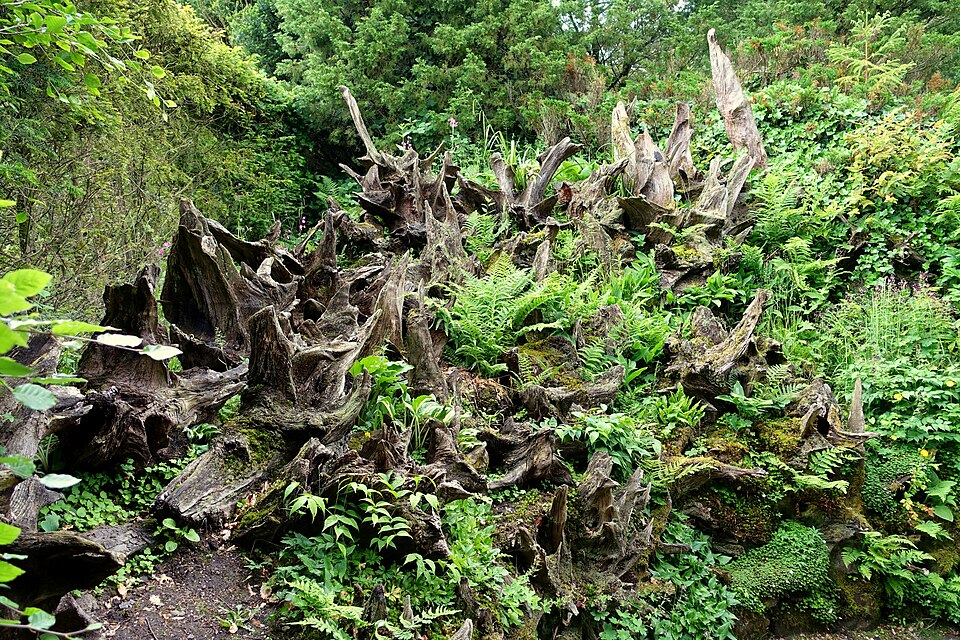
Stumpery (Victorian)
A feature composed of tree roots and stumps placed upside down into earth banks, with trailing plants festooned around them. A stumpery has been restored at Biddulph Grange, Staffordshire, and there is another at Ickworth, Suffolk.
Temple
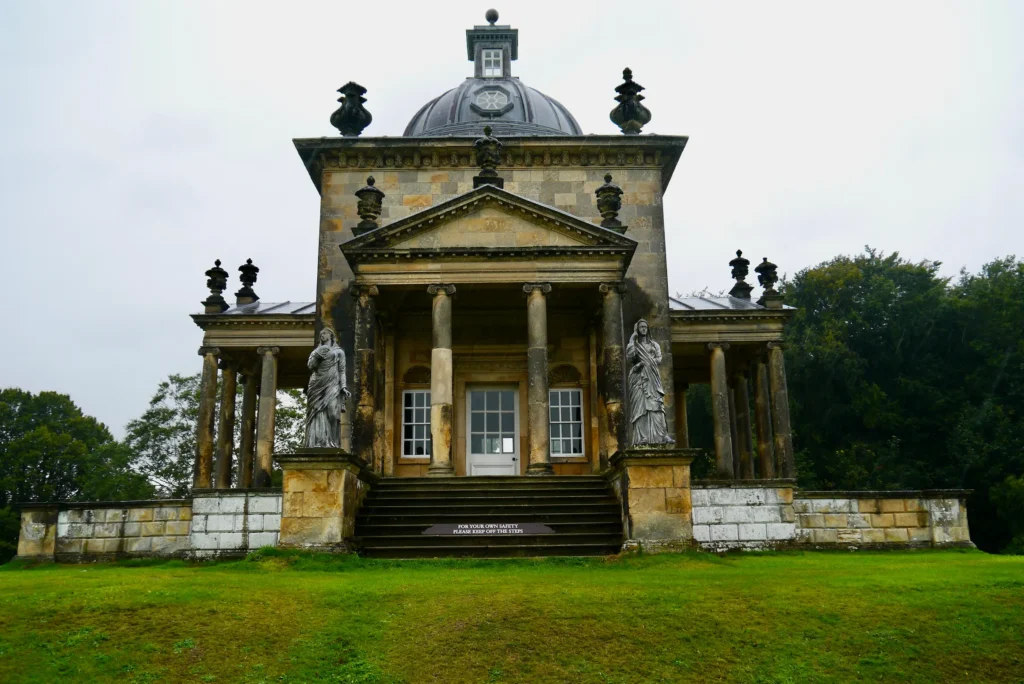
A garden building, generally in Gothic or classical style. The term can be applied to many types of garden building with interior space in which to stand or sit, with or without walls. Many temples have a name (Temple of Venus, Temple of Ancient Virtue) or are characterised architecturally as Gothic Temple or Doric Temple. Some may even be of rustic style, like the former bark temple at Exton, Rutland.
Tudor garden
Some principal characteristics of Tudor gardens were mazes, mounts and knots. Large gardens such as that at Hampton Court, Middlesex, had elaborate , sculpture in wood, of an heraldic kind, such as that re-created in the Tudor House Museum garden, Southampton, Hampshire. The term is also used for a Victorian-period revival of Tudor layout and ornamentation. Read our Garden History Hub article on Tudor gardens here.
Wilderness
Basically a designed grove or wood with paths cut through it. The essence of a wilderness is that it is ornamental, an attractive area in which to wander or pause. In formal gardens it was laid out at some distance from the house, beyond the parterre. The shape of the grove was usually regular though the design within it could be varied. Trees were generally laid out in rows (e.g. Wilton House, Wiltshire, 1630s, or Kirby Hall, Northamptonshire, late seventeenth century). At Ham House, Surrey (1671), the now restored wilderness comprises an area with several paths and compartments delineated by hornbeam hedges. These compartments contain some trees behind the hedges but are also quite open, with grass, flowering shrubs, paths, seats and statuary. Trees and shrubs in a wilderness could be of many different species mixed together. By the early eighteenth century paths wriggled and wound, and at Wray Wood, Castle Howard, North Yorkshire, straight allées were converted into serpentine paths. Later on, in the more naturalistic landscapes of the late eighteenth and early nineteenth centuries, a wilderness would be an informal woodland area of mixed species.
These definitions are taken with kind permission from Michael Symes, Glossary of Garden History (Shire, 2006). Copies are widely available to purchase online.