
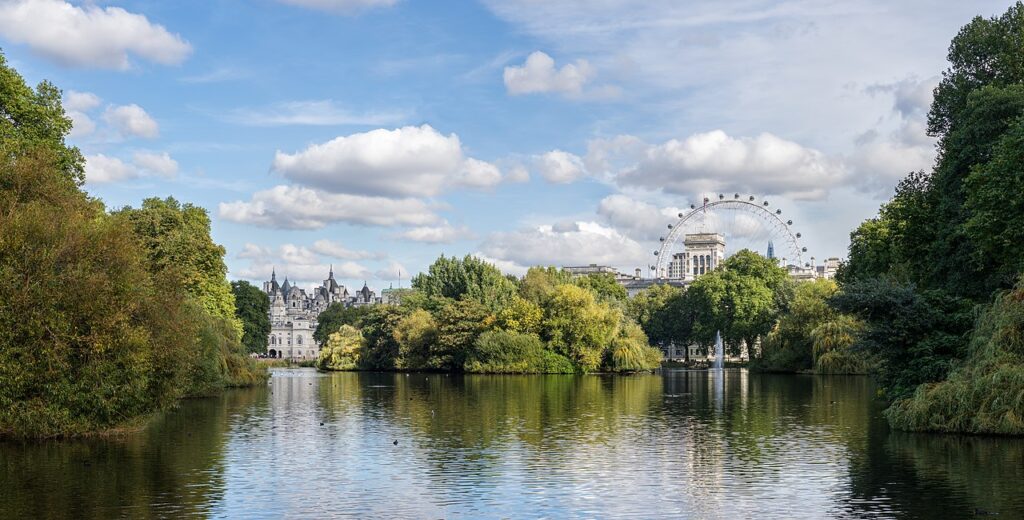
Our Chair John Watkins has been delighted to attend a celebration of the final designs for the national memorial to Queen Elizabeth II in St James Park, a Grade I Registered landscape, which were revealed to coincide with the hundredth anniversary of her birth.
The Gardens Trust was consulted on the memorial garden at an early stage and on the planning application for this work, as a statutory consultee in the planning system and were pleased make recommendations on the plans, which including installing figurative sculptures, a replacement bridge and new planting as well as undertaking work to the Marlborough Gates and relocation of the public conveniences, kiosk, gas lamps and The Boy Statue. John Watkins said: “Involvement in consultations like these are a key way we work with others to enhance and protect our parks and gardens for future generations, ensuring that we, and those who come after us, can enjoy the very best we can create and conserve for them.”
The memorial’s site already forms part of a nationally significant commemorative landscape, and the Gardens Trust recognises that carefully considered change within a historic park can be appropriate when it respects the landscape’s significance and accommodates public use, such as in this proposal.
St James’s Park originated in 1531 when Henry VIII acquired the site of the former hospital of St James and enclosed the surrounding land as a royal hunting park associated with St James’s Palace. In the seventeenth century, the park was significantly redesigned under Charles II, introducing a formal layout influenced by French garden design centred on the long ornamental canal and structured avenues. The Registered landscape has since evolved through successive phases of landscaping, planting and architectural additions, resulting in the layered historic landscape seen today. It remains one of London’s most significant historic parks, valued for its royal origins, designed vistas and continuing role as a major public open space.
The Gardens Trust team considered the comprehensive application, including the policy documentation, the design proposals outlined in the Design and Access Statement, and the assessment of impacts on the historic landscape and townscape contained within the Heritage and Townscape Visual Impact Assessment (HTVIA). The Gardens Trust broadly supports the proposed memorial, agreeing it could enhance the historic landscape if carefully designed to respect its significance. We also made recommendations regarding visitor capacity, ensuring provision of quiet spaces, and the planned meadow-style planting, recommending further refinement to better preserve the park’s character and usability. We welcome the proposed location and support the underlying principles of the masterplan, including the intention to create a sequence of meaningful experiences reflecting the core values associated with Queen Elizabeth II. We also support the intention that the masterplan and its primary features should respect the scale and spirit of John Nash’s Picturesque landscape vision for St James’s Park, respond to the monumental formality of The Mall, and integrate sensitively within the existing character of the park.
The Gardens Trust is also supportive in principle of the proposed path layouts, the reconfiguration of entrance gathering areas, and the proposed sculpture settings at Marlborough Gate and Birdcage Walk. However, our planning application response did also highlight concerns that the capacity of these routes and associated hard landscape spaces may not adequately accommodate the increased visitor numbers likely to arise from the creation of a national memorial of this significance. In particular, the limited number and relatively small scale of the proposed seating areas intended for quiet contemplation may prove insufficient to provide genuinely tranquil spaces. We suggested that although the proposals are tightly defined by the red line boundary, a broader appraisal of visitor movement across the wider park landscape may identify opportunities for additional contemplation spaces located slightly beyond the main memorial corridor but linked to it physically and through interpretation.
